maquette Start a board
For curators and galleries

Hang the show before the install.

Plan an exhibition with the artist in a room you can both walk through: frames, mats, walls, windows and light, from wherever you each are.

Start a board No account for your first board.
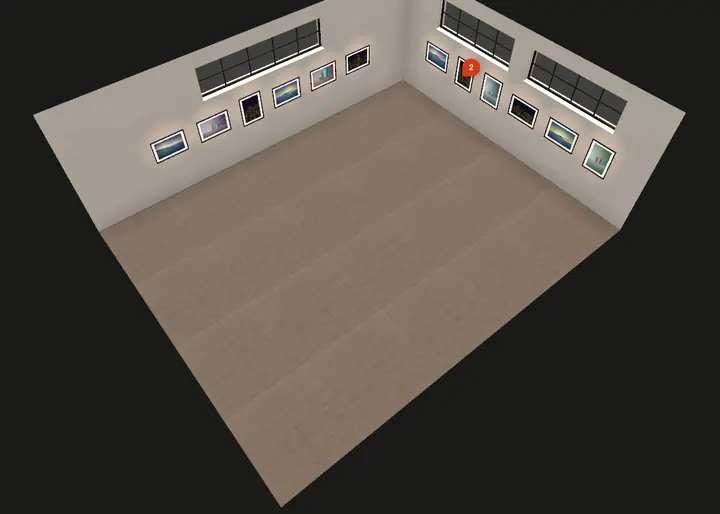
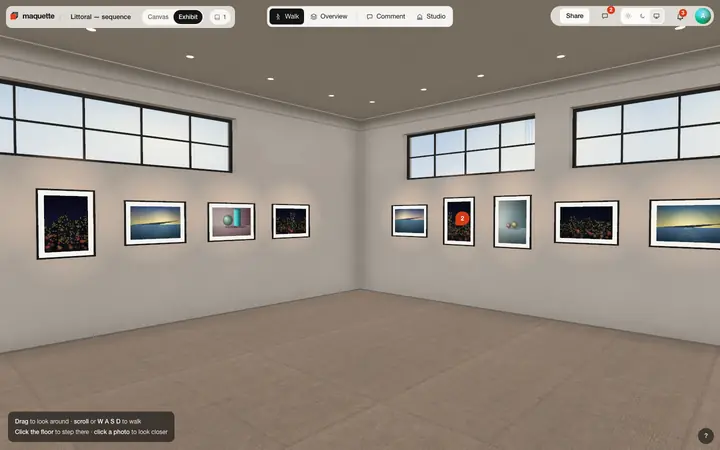
The exhibit: framed photographs along two plaster walls under clerestory windows, a concrete floor.
What gets in the way

A floor plan doesn't show a wall.

  1. Elevations and guesswork.Scaled thumbnails on a plan say little about how a sequence reads at eye level.
  2. The artist is in another city.Decisions wait for site visits or happen over screenshots.
  3. Every change is a new PDF.Move one work and three documents go out of date.
How it works for you

From the works to the walls.

The board holds the works and their order; the exhibit is the same board, hung.

01

Start from the works

The artist uploads to a board; you sequence together. Reading order becomes hanging order.

  • Live. Both of you move prints, each with your own undo.
  • Sections. One titled frame per room or chapter of the show.
  • Private until you share. You decide who can view and who can edit.
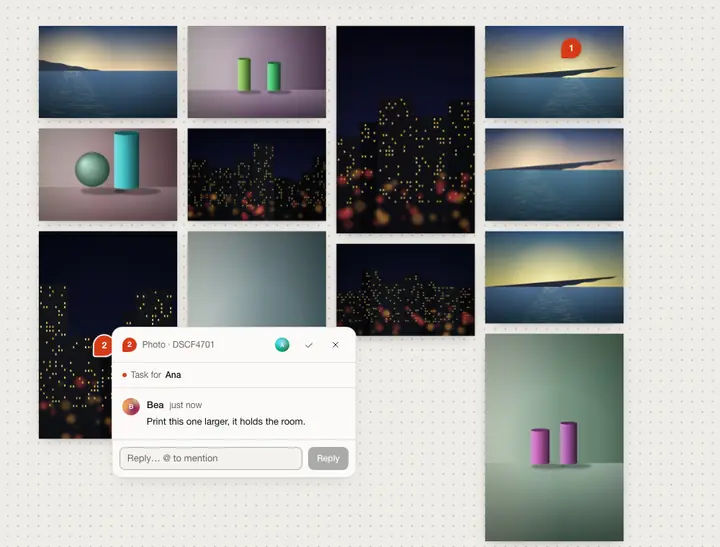
A board with twelve photographs of sea, still lifes and night streets in four columns, two comment pins, Bea's cursor among them.
Board · the works, in order
02

Hang it in a room

One click hangs everything along the walls in order. Then shape the room around the work.

  • Room size, free-standing walls. Add walls, move them, hang on both sides.
  • Windows. Tall, horizontal or clerestory, dragged to any wall.
  • Overview. See the whole room from above.
Uses: Exhibit
The exhibit seen from above: two walls of framed photographs, windows above them, a comment pin on one print.
Exhibit · overview
03

Frames, mats, walls and light

Try a darker wall, a wider mat, an oak floor. Changes are live for everyone in the room.

  • Frames and mats. For one work or the whole room.
  • Walls and floors. Plaster, concrete, linen or brick; oak, concrete, stone or ebony.
  • Ceiling and light. Cornice, plain or open; warm to daylight, a downlight per work.
Uses: Exhibit
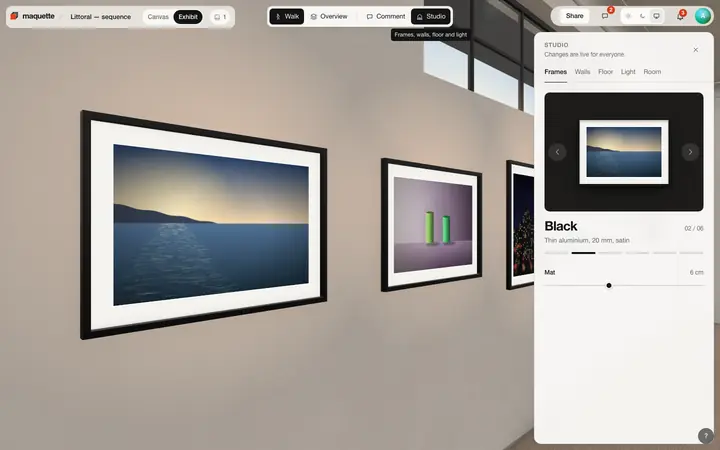
The studio panel beside a framed print: frame Black, thin aluminium, and a mat width slider.
Studio · frames
04

Walk it together, note it on the wall

Walk the room with the artist, each as a figure in your colour. Pin a note to a spot on a wall or to a print.

  • Walk. Scroll or WASD, or click the floor to step there.
  • Notes in the room. Comments pinned to walls and prints, with mentions and tasks.
A comment pinned to a night photograph, assigned to Ana: Print this one larger, it holds the room.
A note pinned to a print, with a name on it
05

The catalogue

Make a book from the same board: one page per work, in hanging order, ready to edit.

  • Index and plates. Generated, with page numbers.
  • Covers. Colour, material, artwork.
  • For the printer. A print-ready PDF with bleed, crop marks and the spine.
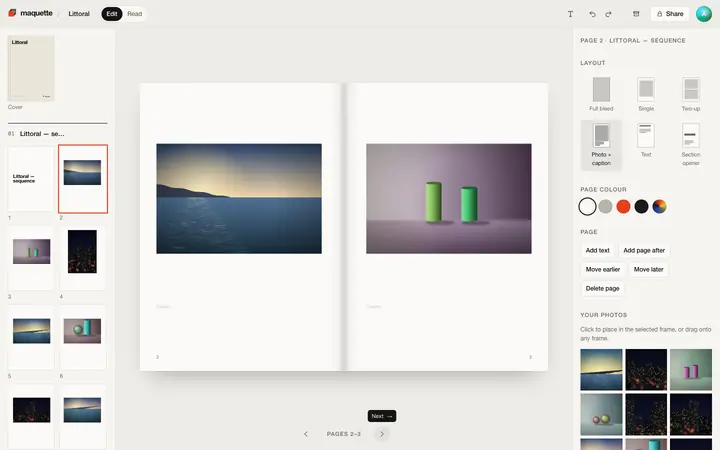
The book editor: the list of pages, an open spread with two captioned photographs, layouts and photos.
Book editor · the catalogue
Six weeks to the openingA scenario to show how the pieces fit, not a customer quote.

A curator in Lisbon and a photographer in Oslo hang twenty-two works in the room together on a call. They try a darker wall, move three works to a free-standing wall and pin a note where the window light falls.

The gallery's director walks it from a view-only link. The catalogue starts as a book made from the same board.

Plan the hang.

Start a board No account needed. A guest board holds 4 photos for 7 days; sign in and it's yours to keep. Or leaf through a sample book
Solutions

Also made for.

The same boards, rooms and books, from another seat at the table. Or see every feature.